
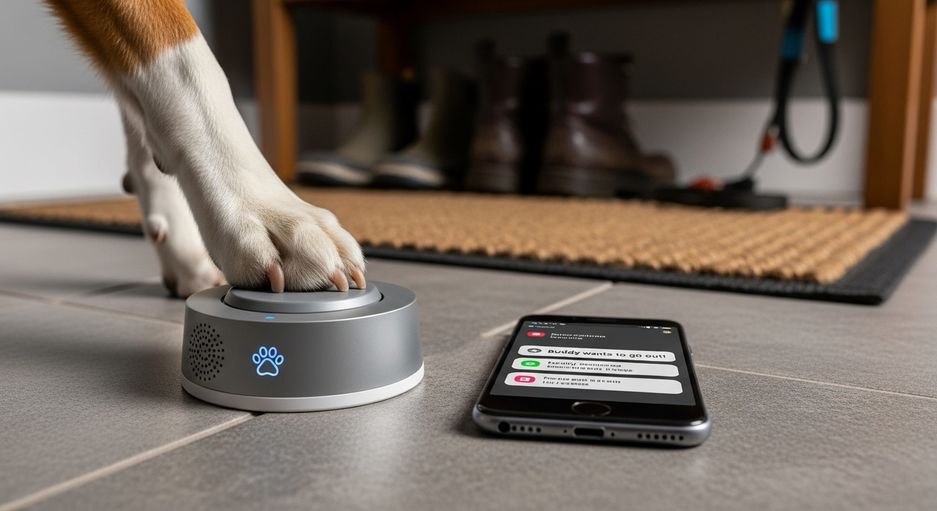
Social media posts and news stories alike showing dogs pressing buttons to “say” words like “outside”, “play”, or “treat” have sparked curiosity among dog owners everywhere. But do these buttons really help dogs communicate? The answer isn’t quite as simple as yes or no.
While communication buttons can be a fun and rewarding training activity, they’re only one piece of the communication puzzle. Like any training tool, communication buttons are most effective when they’re built on a strong understanding of how dogs naturally communicate.
How Do Dog Communication Buttons Work?
Dog communication buttons are programmable buttons that play a recorded word or phrase when pressed.
Like many other aspects of dog training, communication buttons rely on repetition, consistency, and positive reinforcement. Over time, some dogs learn to associate specific buttons with particular outcomes. For example, pressing “outside” may lead to a trip outdoors, while “treat” may result in their owner rewarding them with a treat.
Research into canine cognition continues to grow, and studies suggest that dogs are capable of learning symbolic associations between words and objects or actions. This supports the idea that communication buttons are less about teaching dogs to “talk” and more about helping them connect words with predictable outcomes.
Think of it like a young child learning that saying “up” reliably results in being picked up. At that stage, they’re not necessarily having a complex conversation; they’ve simply learned that a particular word consistently produces a predictable response.
Does Every Dog Need Communication Buttons?
Communication buttons can be a fun form of mental enrichment for some dogs, offering another way to engage with their environment, challenge their minds, and practice problem-solving. However, they’re not necessary for helping you and your dog communicate effectively.
Before introducing communication buttons, it’s worth asking an important question: How well do you already understand your dog’s natural communication?
Dogs already communicate with us every day. While they may not be able to communicate through spoken language the way humans do, they communicate constantly through body language, facial expressions, posture, movement, vocalizations, and behavior.
So, while a communication button may help some dogs express a request, understanding your dog’s everyday behavior helps you better understand everything they’re trying to communicate.
Better Communication Starts With Better Understanding
At the end of the day, communication buttons are simply another training tool—and like any training tool, they’re most effective when they’re built on a strong foundation of trust, understanding, and clear communication.
For most dogs—whether they’re household pets or a working service dog—clear communication, reliable behaviors, and handler awareness are what matter most; and building those fundamentals through virtual training creates a much stronger partnership than relying on communication buttons alone.
Whether you’re raising a family companion, preparing a service dog, or simply looking to strengthen your relationship, professional training lays the groundwork for building trust, confidence, and a strong bond.
At Fetch and More, our one-on-one virtual obedience training and virtual service dog training programs focus on helping you better understand your dog while building the skills and communication needed for lasting success.
Whether you’re just beginning your training journey or looking to build on the progress you’ve already made, we’re here to help you and your dog learn together. Visit our virtual training courses page to get started, or contact us to learn more.