
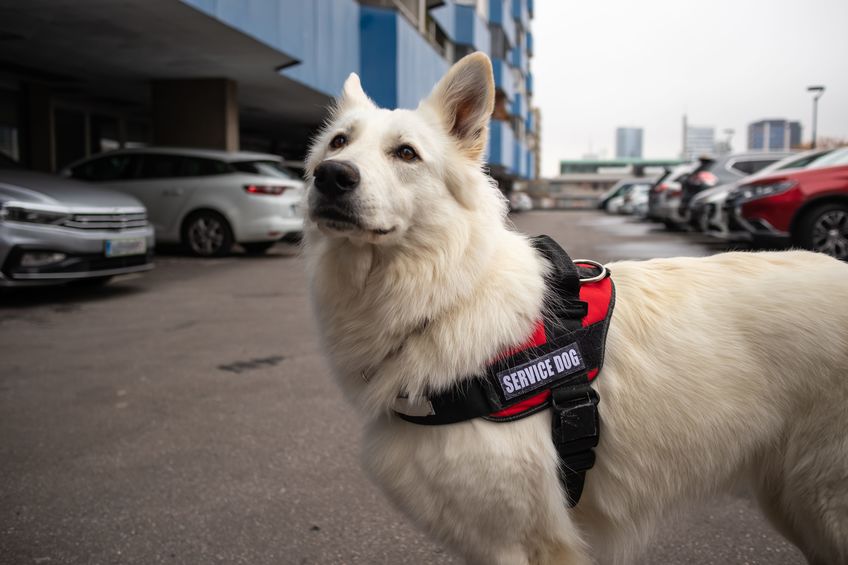
For years, conversations about stress management have focused on therapy, medication, lifestyle changes, and, more recently, botanical adaptogens such as ashwagandha and rhodiola. But what if one of the most powerful tools for helping the body adapt to stress isn’t found in a supplement bottle at all?
That question sits at the heart of a new research paper by Fetch and More founder and Lead Trainer, John Bellocchio.
The paper, titled “The Service Dog as Living Adaptogen: Comparative HPA Axis Modulation Through Botanical and Bond-Based Naturopathic Interventions” explores the possibility that service dogs may influence the body’s stress-response systems in ways that resemble—or even surpass—the mechanisms traditionally associated with adaptogens.
This blog will walk through the paper’s key concepts, the science behind them, and what they could mean for our understanding of service dogs and stress. Throughout the article, we’ve also included Bellocchio’s own thoughts and insights to help bring the research to life. If you’d like to explore the complete research after reading, we’ve included a link to download the full paper at the end of this article.
Key Terms Used in This Research
Before we get into the paper, its findings, and their broader implications, it’s important to be familiar with some key terms and concepts that appear throughout the paper:
- Adaptogen: A natural substance, typically an herb or plant, believed to help the body adapt to stress and maintain physiological balance. Common examples include ashwagandha and rhodiola.
- Cortisol: Often referred to as the body’s primary stress hormone, cortisol helps regulate energy, metabolism, immune function, and the body’s response to stressful situations.
- HPA Axis: Short for the hypothalamic-pituitary-adrenal axis, this is the body’s central stress-response system. It governs the production of cortisol and plays a major role in how people react and recover from stress.
- Human-Animal Bond: The mutually beneficial relationship between humans and animals. Research suggests that strong human-animal bonds can influence emotional well-being, stress levels, and overall health.
- Oxytocin: Sometimes called the “bonding hormone,” oxytocin is associated with trust, social connection, and emotional attachment. Positive interactions between humans and dogs have been shown to stimulate oxytocin release.
- Vis Medicatrix Naturae: A foundational concept in naturopathic medicine meaning: “the healing power of nature.” It refers to the body’s innate ability to restore balance and support healing when given appropriate conditions and support.
- Cortisol-Perception Disconnect: A concept introduced in the paper describing situations where measurable cortisol levels and a person’s lived experience of stress do not align. For example, someone may report feeling calmer and more stable even when cortisol measurements show little change.
- Living Adaptogen: A term proposed in the paper to describe how a service dog may help regulate a handler’s stress response through training, partnership, and the human-animal bond. The term refers to a function or mechanism rather than a product or supplement.
Why This Research Matters
For many people living with disabilities, chronic stress, anxiety, PTSD, or other health challenges, a service dog is often described as “helpful.” While true, that description barely scratches the surface.
When discussing what inspired the research, Bellocchio explained that years of working alongside service dog handlers revealed a recurring pattern: handlers would arrive carrying the weight of hypervigilance, anxiety, and constant stress, only to demonstrate a noticeable shift once their service dog became involved. The stress didn’t magically disappear, but something important happened: the person’s system began to settle.
“I wanted to understand what was actually happening there, because the service dog community deserves better than ‘it just helps.’”
Understanding the Living Adaptogen Concept
Adaptogens are traditionally defined as substances that help the body maintain balance under stress. Rather than stimulating or sedating, they are believed to support the body’s ability to adapt—hence the name.
When researching how adaptogens work, Bellocchio realized that the definition closely mirrored what he had observed in thousands of service dog partnerships.
“The vocabulary already existed. It just belonged to a bottle on a shelf instead of to a dog on a leash.”
The phrase “living adaptogen” is not meant to compare a dog to a supplement. Instead, it describes a function: a service dog may help modulate stress responses and encourage adaptation when life becomes overwhelming.
It’s important to understand that a service dog is not a replacement for medical care, therapy, or other treatments. Rather, the partnership works because of training, trust, and the active participation of both handler and dog, allowing the dog to help regulate how the handler responds to stress.
When asked how readers should interpret the phrase “living adaptogen” and what he hopes they don’t misunderstand, Bellocchio emphasized that it describes how a service dog may work—not what a service dog is:
“Understand it as a description of a function, not a label for a product. The dog modulates the handler’s stress response. It helps the system adapt instead of either collapsing or staying locked in alarm. That is the whole of the analogy. Here is what I don’t want misunderstood: the dog is not a supplement you dose. It is not a pill with fur. It does not work without training, without the bond, without the handler doing the work alongside it. And it is not a replacement for a doctor or a therapist. The word “adaptogen” explains a mechanism. It does not reduce a living partner to a remedy.”
The Cortisol Perception Disconnect
One of the most compelling ideas introduced in the paper is what Bellocchio calls the “cortisol-perception disconnect.”
Cortisol is often used as a biological marker of stress, and many adaptogen studies focus heavily on whether cortisol levels increase or decrease following an intervention. However, the research reviewed in the paper suggests cortisol measurements don’t always tell the entire story.
Bellocchio describes the disconnect simply: “The number in the lab and the feeling in the body do not always move together.”
In other words, biological measurements don’t always reflect how a person actually experiences stress or recovery—in fact, in some cases, individuals report feeling significantly calmer, safer, and more resilient, even when measurable cortisol changes remain small or inconsistent.
When discussing why that distinction matters, Bellocchio explained: “This matters because we have a bad habit of trusting only what we can measure. If we judge a service dog by a single biomarker, we miss most of what it does. The dog is not sedating a chemical. It is changing how a person meets their own life.”
What the Research Suggests About Service Dogs and Stress
The paper synthesizes findings from both adaptogen research and human-animal bond studies. While additional research is needed, several recurring themes emerged.
Service dog partnerships have been associated with:
- Improved regulation of stress responses
- More normalized cortisol awakening responses
- Increased activation of oxytocin-related pathways
- Greater feelings of safety, stability, and emotional regulation
- Enhanced ability to recover from stressful situations
One of the most important conclusions is that service dogs may not eliminate stress altogether. Instead, they may help people recover from stress more effectively.
“A service dog does not turn off your stress. It teaches your body how to come back from it. That is a different thing, and it is the more durable thing.”
What These Findings Mean in Practice
Research findings are important, but for most people, what matters most is what they mean in everyday life.
When asked what these findings mean for someone considering a service dog, Bellocchio offered this perspective:
“Go in with the right expectation. A service dog is not going to erase your hard days. What a well-trained one will do is shorten them, soften them, and give your body a reliable way back to the ground. That is a partnership, and it asks something of you in return. If you want a cure you swallow, this is the wrong path. If you want a partner who helps you carry it, this is exactly right.”
This perspective aligns with what many handlers report over time: success often comes not from eliminating challenges, but from increasing resilience and improving quality of life.
The Future of Human-Animal Bond Research
The paper also highlights several opportunities for future study. One of the most promising areas involves understanding why perceived well-being and physiological measurements sometimes diverge. Rather than asking only whether cortisol drops, future research may need to focus on what service dogs are regulating and how those mechanisms work.
“I would like to see the research stop asking, ‘Does cortisol drop?’ and start asking, ‘What is the dog actually regulating, and how?’ The honest answer right now is that we are watching something real that we cannot yet fully explain. That is not a weakness. That is where the interesting work is.”
As scientists continue exploring these questions, the service dog community may gain a deeper understanding of the biological and psychological benefits that handlers have reported for decades.
Reframing the Role of Service Dogs
Perhaps the most meaningful takeaway from this research is that service dogs deserve to be viewed as more than assistive animals alone. They are highly trained partners whose influence may extend beyond task performance and into the regulation of stress, recovery, and resilience.
Bellocchio believes this shift in perspective extends beyond prospective handlers. When asked how healthcare providers, therapists, families, and prospective clients should interpret the research, he said:
“Stop treating the service dog as the soft option or the last resort, and stop measuring it by the wrong yardstick. [Service dogs] belong inside the care plan, next to the medication and the therapy, not underneath them. And do not dismiss what the handler reports just because a chart doesn’t echo it. The handler living the life is the most important instrument in the room.”
The paper also highlights the need for broader representation within human-animal bond research, particularly among guide dog handlers and individuals who are blind or visually impaired. Expanding research to include these populations may help deepen our understanding of how service dogs support health and well-being across diverse communities.
For those exploring whether a service dog could improve daily life, the question may no longer be whether a dog can help. Instead, the question becomes: how does a trained service dog help the body adapt, recover, and regain balance in ways that traditional interventions sometimes cannot?
Download the Full Research Paper
Research grows through conversation, and we’d love to hear your thoughts after reading the paper. Whether you have questions, feedback, or simply want to continue the discussion, we’d be happy to hear from you.
To learn more about Fetch and More’s services, philosophy, and evidence-based approach, explore our website, browse our blog, or contact our team with any questions.