
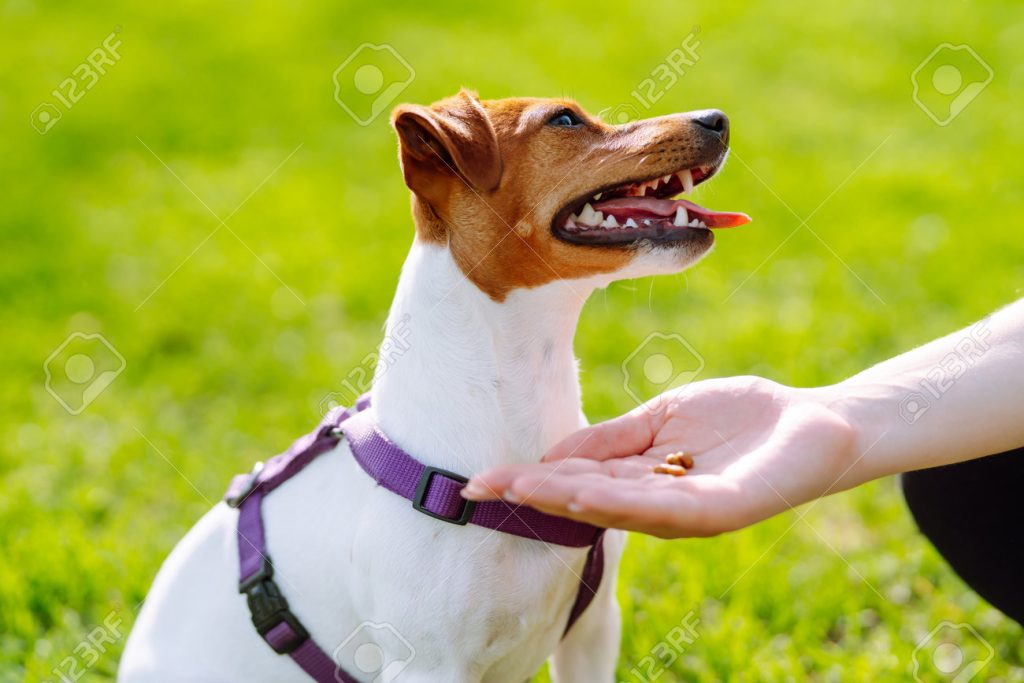
Most dog owners know that treats are an invaluable part of an incentive structure during training. The trainer gives a dog a command using a certain word or phrase, and if the dog responds with the desired behavior, the trainer will reward them with a treat. This teaches the dog to associate the behavior with the treat, which incentivizes them to repeat the desired behavior. This is called operant conditioning, and it’s one of the foundations of dog training as a practice.
Whether your dog needs house training or instruction for more advanced applications, understanding how and why dogs respond to treats is critical to making sure the process is successful.
The Utility of Positive Reinforcement
Positive reinforcement is one of the most effective and widely recommended approaches to dog training. The concept is simple: when a dog performs a desirable behavior, a reward follows. This encourages the dog to repeat that behavior.
It’s also important to understand the difference between positive and negative reinforcement. Positive reinforcement involves adding something desirable to encourage a behavior. Negative reinforcement involves removing something unpleasant when a desired behavior occurs, increasing the likelihood of that behavior happening again.
What Research Tells Us About Reward-Based Dog Training
Dog training has come a long way, and modern behavioral research continues to broaden our understanding of how dogs learn. Researchers increasingly examine whether a training method produces certain behavior and how that method affects a dog’s emotional well-being.
A 2020 peer-reviewed study published in PLOS ONE examined 92 companion dogs attending training schools using reward-based, mixed, or aversive-based methods. Researchers observed that dogs exposed to higher proportions of aversive training methods displayed more stress-related behaviors, experienced greater increases in cortisol after training, and showed less favorable responses in a cognitive bias assessment than dogs in reward-based programs.
More recent research is also examining the relationship between training practices and behavioral development over time. A 2025 study using data from the Generation Pup longitudinal project explored associations between training methods and owner-reported problem behaviors across different stages of a dog’s development.
Timing and Consistency Make All the Difference
Dogs have a much more limited understanding of cause and effect than humans do, and dog owners who don’t keep this in mind will often confuse their dogs by reacting to their behaviors the wrong way at the wrong time.
This is why yelling at a dog after finding a mess they’ve left behind is highly ineffective. The dog doesn’t understand why they’re being yelled at, or how to behave to prevent it from happening again. To the dog, the owner’s outburst appears completely unrelated to the behavior that incited it.
When using a reward system to train a dog, it’s imperative that you administer the reward immediately after the desired behavior, and without any other behaviors in between. If you command your dog to sit, for instance, you should give them the treat as soon as they sit. Waiting too long will not only cause them to forget the connection between the action and the reward, but it may also accidentally cause them to associate actions that are completely unrelated to the reward, like standing up and walking away after sitting.
Personalized Dog Training Creates More Successful Outcomes
No two dogs learn exactly alike. Age, previous experiences, temperament, environment, and individual behavioral challenges can all influence how quickly a dog develops reliable bathroom habits. A young puppy learning the basics may need an entirely different approach from an adopted adult dog with an established history of indoor accidents.
Successful training takes time, consistency, and patience. If house training has become a challenge, or if a dog needs a more individualized approach, professional guidance can make the process much more manageable.
Fetch and More helps dogs and their owners develop practical skills, understand behavioral patterns, and build a training approach suited to their individual circumstances. Our specialized virtual training courses also extend to emotional service dog training, search and rescue, and guardian dog training. Get in touch with us at 201-914-8268 to learn more about our programs.